

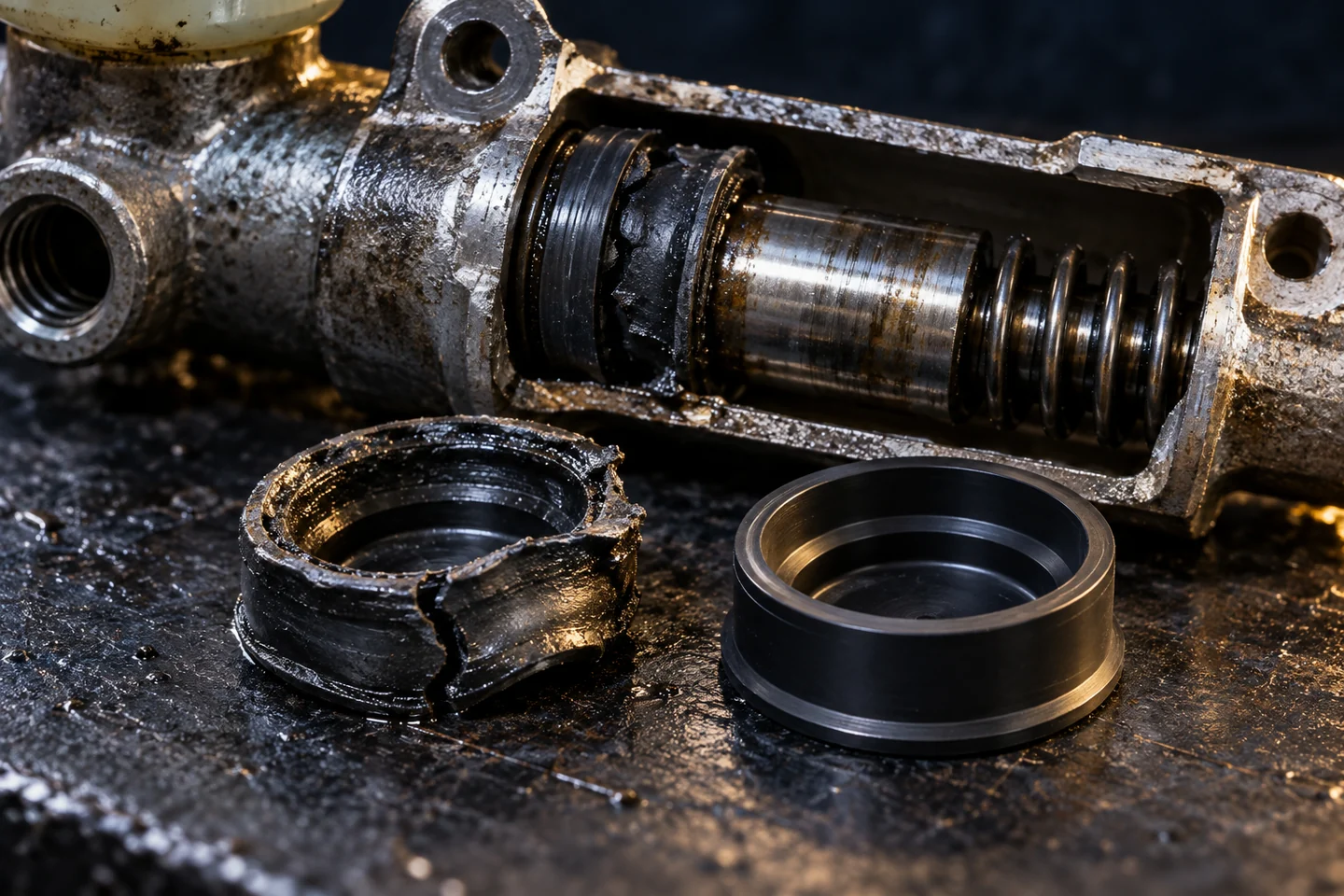
A CSC is a hydraulic release bearing: slave cylinder and throwout bearing in one sealed unit. It changes the failure mode, the bleed procedure and the replacement cost. Here is what to check before you quote one.
A concentric slave cylinder — CSC, also sold as a hydraulic release bearing — combines the slave cylinder and the throwout bearing in one sealed unit that sits around the gearbox input shaft. There is no pushrod and no external lever, so the hydraulic circuit ends inside the bellhousing.
Why the CSC replaced the external cylinder
Three reasons, and none of them are about better hydraulics. It removes a lever and a return spring from the assembly line, it self-compensates as the clutch plate wears, and it takes less space inside a crowded modern engine bay. The trade-off is serviceability: when the seal fails, the gearbox has to come out.
That matters for pricing. An external slave cylinder is a twenty-minute job on most vehicles. The same leak on a CSC is a clutch job, so the part price is a small share of the customer's real cost.
What fails first, and how the driver describes it
The internal seal is usually the first casualty, and it fails into the bellhousing rather than onto the road, so nothing appears under the car. Buyers then describe one of four symptoms:
- The pedal sinks slowly to the floor and pumping restores it for a while.
- Gear engagement gets harder when the car is hot, because air enters the circuit.
- Brake and clutch fluid keeps disappearing with no visible leak.
- A squeal or rumble when the pedal is pressed, from the bearing face rather than the hydraulics.
The fourth symptom is worth separating. A noisy bearing with a firm pedal and a stable fluid level is a mechanical failure of the release bearing, not a hydraulic leak, even though the part is the same on many cars.
Why the OE number is a fitment key, not a specification
For external cylinders buyers can often compare bore and port thread directly. A CSC is sealed, and the meaningful dimensions — height above the mounting face, bearing contact diameter, port orientation — are not published by the vehicle makers. Matching on the OE number is the only reliable route:\n\n
| What a buyer asks | Can it be confirmed | How |
|---|---|---|
| Will it fit this gearbox | Yes | OE number and gearbox code, cross-checked against the factory catalogue |
| Bore diameter | Rarely | Not published by most vehicle makers; the CSC is bought as an assembly |
| Port thread | Yes | Visible on the unit; M10x1 and M12x1 cover most European and Japanese applications |
| Bearing contact height | No | Sealed unit; only the OE reference guarantees it |
What to send with a CSC enquiry
For a quote that does not come back twice, send the OE number from the old unit, a photo of the flange side, the gearbox code if it is visible, and the vehicle's model year. Where the customer only has the vehicle details, we work back from the factory catalogue and confirm the part number before any price is given.
We supply concentric cylinders within the clutch slave cylinder line, alongside the external version. As with every part on this site, the quotation names the OE reference the part replaces, so the customer can check it against stock without asking us to prove it.