

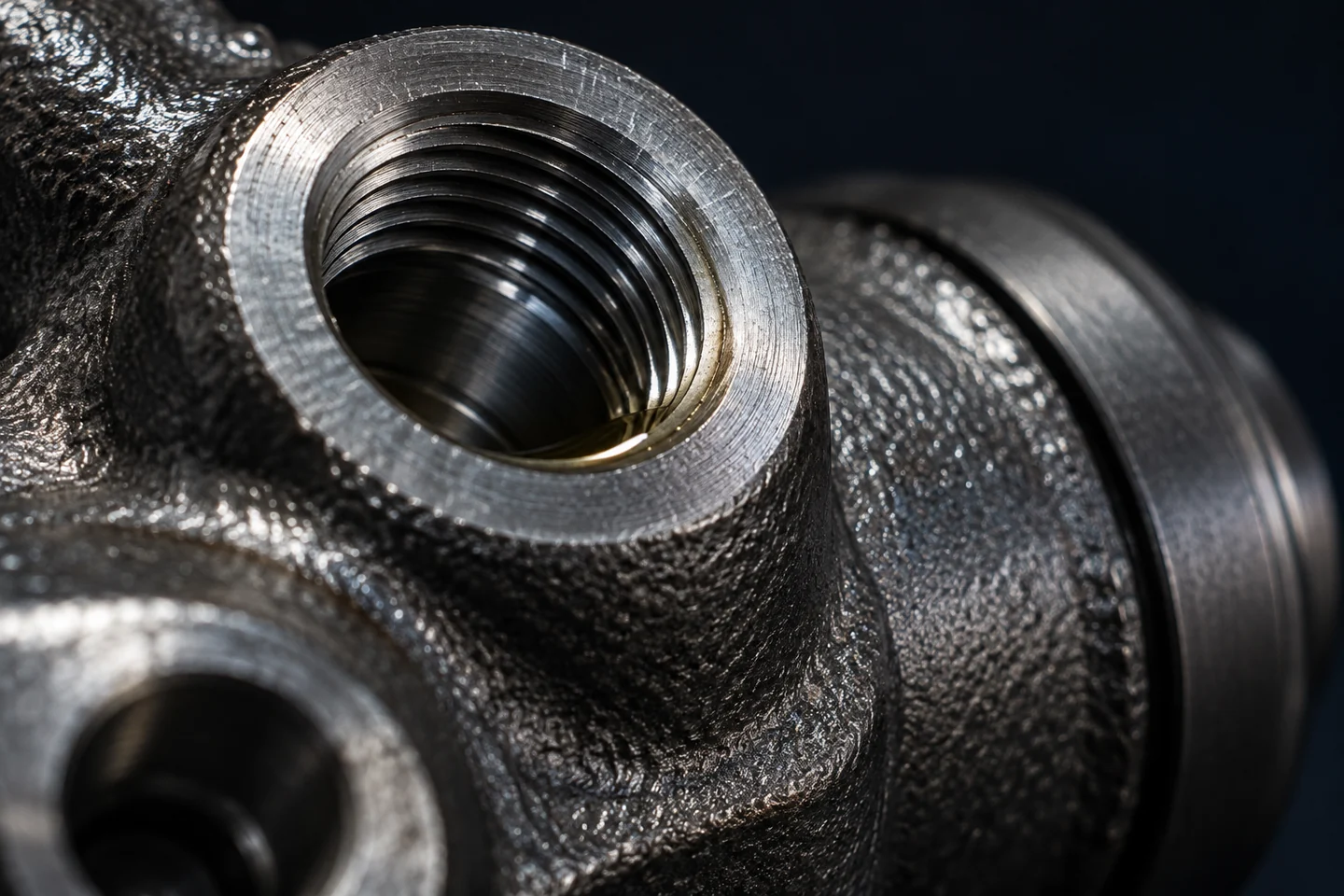
A kit costs a fraction of a cylinder — until the bore is pitted or the piston is scored. These are the checks that decide whether a rebuild will hold, and when it will come back.
Rebuild a brake or clutch cylinder only when the bore is smooth and still within tolerance. If the bore is pitted, scored or out of round, a new seal will fail again within weeks — and the customer will blame the kit, not the bore.
What a repair kit actually replaces
A kit restores the sealing surfaces and the moving seal, not the housing. On most brake and clutch cylinders that means the cup or lip seal, the piston, the dust boot and sometimes the spring. What it never replaces is the bore itself, which is the part that wears oval on high-mileage units.
- Cup and lip seals, sized to the original bore — a 22.22 mm kit will not seal a 23.81 mm bore.
- Piston and, where fitted, the expander.
- Dust boot, which is the only barrier against road salt and grit.
- Springs and retainers on clutch slaves, where the return spring sets the release point.
Three conditions that rule out a rebuild
First, visible pitting or a ring of corrosion where the seal parked. Second, a bore that measures out of round with an internal micrometer or a pass/fail bore gauge. Third, a scored piston skirt, which means debris has been circulating and the bore is already damaged.
There is a fourth, commercial rather than technical: if the labour to strip and rebuild is close to the price difference between a kit and a new unit, the rebuild is a bad deal for the workshop even when the bore is perfect.
| Condition found | Kit | New cylinder | Why |
|---|---|---|---|
| Bore smooth, seal hardened | Yes | No | Wear is in the seal, not the housing |
| Light surface staining only | Yes | No | Staining does not affect sealing |
| Pitting or corrosion ring | No | Yes | New seal will be cut by the pit edge |
| Bore out of round | No | Yes | No seal can compensate for an oval bore |
| Scored piston or debris in fluid | No | Yes | Contamination source must be removed |
| Cracked housing or stripped port | No | Yes | Structural failure, not a wear item |
Matching the kit to the bore, not to the vehicle
Repair kits are bore-specific, and the bore is not always the one the vehicle listing implies. The same model year can carry two different master cylinders depending on ABS, market and transmission. Measure the bore, or match the kit to the part number on the housing, rather than to the car.
Seal material matters as much as size. EPDM is the standard for DOT 3 and DOT 4 fluid; a kit built for mineral oil will swell and fail in a glycol circuit. Where a vehicle runs DOT 4, confirm the kit is rated for it instead of assuming.
What to expect from a kit quotation
A kit quotation should name the bore it fits and the seal material, not only the vehicle. If a supplier quotes a kit by vehicle model alone, the risk of a mismatch is on the buyer. We quote cylinder repair kits by bore and by the part number they rebuild, and the same rule applies as everywhere else on this site: the reference on the quotation is the one you can check against stock.